




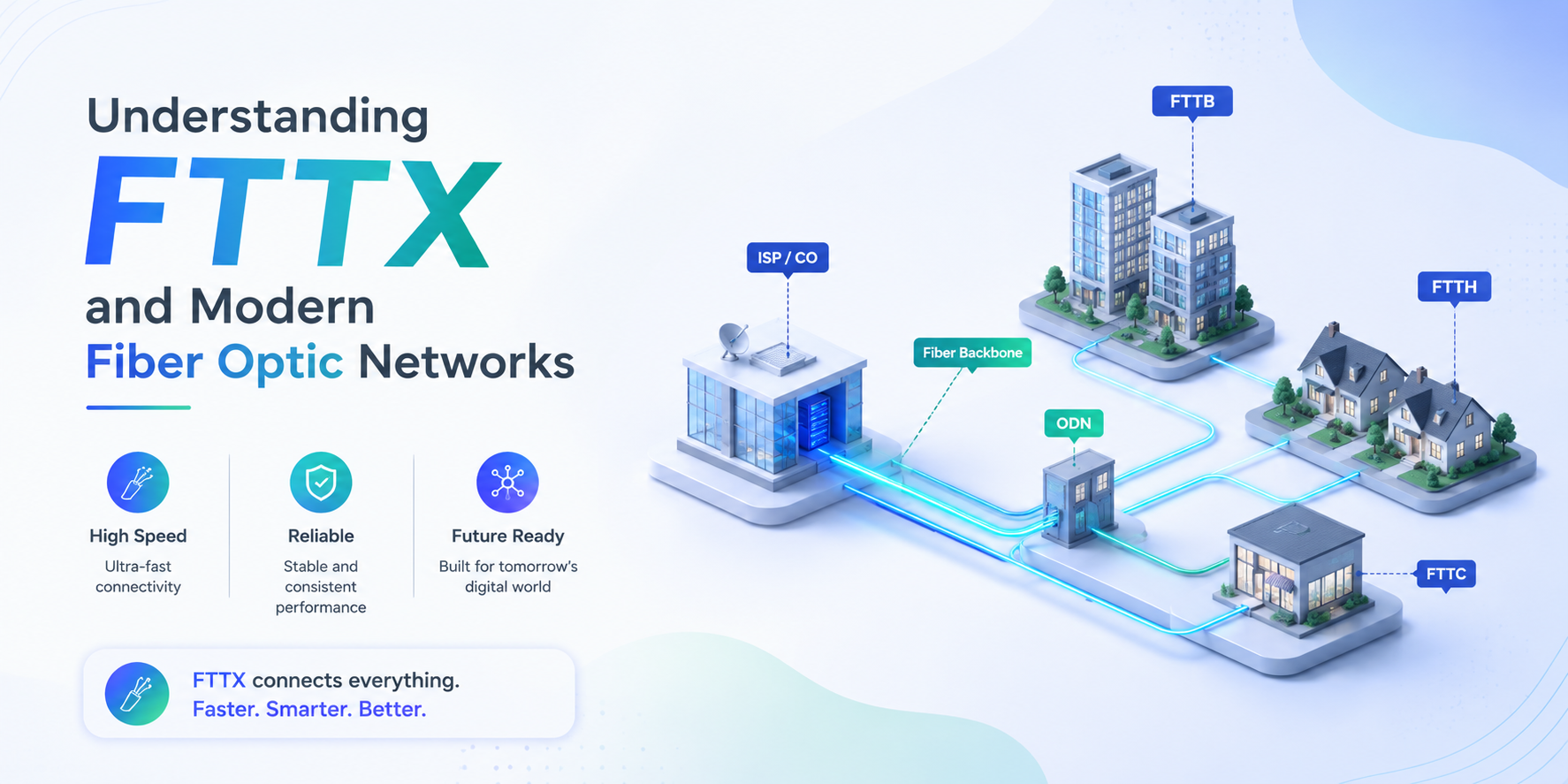
Understanding FTTX and Modern Fiber Optic Networks
Understanding FTTX and Modern Fiber Optic Networks
High-speed internet has become an essential part of modern life, powering everything from online education and remote work to cloud computing, smart homes, and business operations. As the demand for faster and more reliable connectivity continues to grow, fiber optic technology has become the preferred choice for network infrastructure. One of the most widely adopted fiber deployment methods is FTTX (Fiber-to-the-X), a flexible architecture designed to deliver high-performance broadband services to homes, businesses, institutions, and industrial facilities.
This guide explores FTTX technology, its different architectures, essential components, key advantages, and why it plays a vital role in building modern communication networks.
What is FTTX?
FTTX, short for Fiber-to-the-X, is a general term used to describe various fiber optic network architectures where "X" represents the final destination of the fiber connection. Depending on network requirements, the fiber may terminate at a home, office, building, cabinet, or another endpoint before the final connection reaches the user.
Unlike traditional copper-based networks, fiber optic cables transmit data using light signals, allowing significantly higher bandwidth, lower latency, longer transmission distances, and greater reliability.
Common Types of FTTX
FTTH (Fiber to the Home)
FTTH delivers fiber optic cable directly to residential homes. It provides maximum internet speed, excellent reliability, and supports modern digital services including 4K/8K streaming, online gaming, cloud applications, and smart home systems.
FTTB (Fiber to the Building)
In FTTB deployments, fiber reaches the building while internal connections are distributed through Ethernet or structured cabling. This solution is widely used in apartment complexes, office buildings, hotels, and commercial facilities.
FTTC (Fiber to the Curb)
FTTC extends fiber to a nearby street cabinet or curb. Existing copper infrastructure is used for the final connection to individual users, reducing deployment costs while improving network performance.
FTTN (Fiber to the Node)
Fiber terminates at a neighborhood node before reaching customers through existing copper cables. Although slower than FTTH, FTTN offers a practical upgrade path for many service providers.
FTTO (Fiber to the Office)
FTTO connects fiber directly to office environments, providing secure, high-speed, and scalable networking for enterprises, educational institutions, hospitals, and government organizations.
How FTTX Networks Work
An FTTX network begins at the service provider's central office, where an Optical Line Terminal (OLT) transmits optical signals through fiber optic cables. These signals travel across the Optical Distribution Network (ODN) and are divided using passive optical splitters before reaching Optical Network Units (ONU) or Optical Network Terminals (ONT) installed at customer locations.
This architecture enables multiple users to share a single fiber infrastructure efficiently while maintaining high-speed and reliable connectivity.
Essential Components of an FTTX Network
- Fiber Optic Cable
- OLT (Optical Line Terminal)
- ONU (Optical Network Unit)
- ONT (Optical Network Terminal)
- PLC Splitter
- Fiber Distribution Box (FDB)
- Optical Distribution Frame (ODF)
- Fiber Patch Cord
- Fiber Adapter
- Fiber Pigtail
- Fiber Splice Closure
- Network Cabinets and Racks
- Cable Management Accessories
Advantages of FTTX Technology
- Ultra-fast Gigabit internet speeds
- Higher bandwidth capacity for growing network demands
- Lower latency for real-time applications
- Reliable and stable network performance
- Reduced signal interference
- Long-distance transmission with minimal loss
- Lower maintenance costs compared to copper networks
- Scalable infrastructure for future expansion
- Energy-efficient network operation
- Support for smart city and IoT applications
Applications of FTTX
FTTX technology is used across various industries and environments, including:
- Residential broadband services
- Corporate offices
- Educational institutions
- Hospitals and healthcare facilities
- Industrial manufacturing plants
- Government offices
- Data centers
- Telecommunication operators
- Smart city infrastructure
- Commercial buildings and shopping malls
FTTX and GPON Technology
Gigabit Passive Optical Network (GPON) is one of the most widely used technologies in modern FTTX deployments. GPON allows a single optical fiber to serve multiple subscribers through passive optical splitters, significantly reducing infrastructure costs while delivering high-speed broadband services.
Many Internet Service Providers (ISPs) choose GPON because it offers excellent performance, simplified maintenance, and efficient bandwidth distribution.
Why Quality Components Matter
The overall performance of an FTTX network depends heavily on the quality of its components. High-quality fiber optic cables, connectors, splitters, patch cords, distribution boxes, and network accessories help minimize signal loss, improve reliability, and reduce maintenance requirements.
Choosing certified networking products also simplifies installation and ensures long-term network stability, making them an essential investment for both service providers and enterprise networks.
Solitine FTTX Solutions
Solitine provides a comprehensive portfolio of networking and fiber optic solutions designed for modern FTTX deployments. Our product range includes fiber optic cables, PLC splitters, Optical Line Terminals (OLT), Optical Network Units (ONU), fiber patch cords, Optical Distribution Frames (ODF), Fiber Distribution Boxes (FDB), network cabinets, patch panels, and professional installation tools.
Whether you are building a new fiber network or upgrading an existing infrastructure, Solitine offers reliable products that help ensure efficient installation, stable performance, and long-term scalability.
Best Practices for FTTX Deployment
- Use high-quality fiber optic cables and connectors.
- Plan network routes carefully before installation.
- Protect fiber cables from excessive bending and physical damage.
- Test optical loss after installation.
- Maintain proper cable management inside racks and cabinets.
- Use certified passive optical components.
- Perform regular maintenance and inspections.
The Future of FTTX Networks
The future of broadband connectivity depends on fiber optic technology. As demand for cloud computing, artificial intelligence, smart manufacturing, autonomous systems, and next-generation communication continues to increase, FTTX will remain the foundation of modern digital infrastructure.
Governments, Internet Service Providers, and enterprises around the world are investing heavily in fiber deployments to deliver faster, more reliable, and future-ready connectivity.
Conclusion
FTTX has transformed the way people and businesses connect to the digital world. Its flexibility, scalability, and exceptional performance make it the preferred choice for modern broadband infrastructure. By combining advanced fiber optic technology with high-quality networking components, organizations can build reliable communication networks capable of meeting today's demands while preparing for tomorrow's innovations.
Whether you are planning a residential broadband network, an enterprise infrastructure, or a large-scale ISP deployment, choosing premium FTTX solutions from Solitine helps ensure outstanding network performance, reliability, and long-term value.

0 Comments
Be the first to share your thoughts on this post.
Leave a Comment