







How Fiber Optic Networks Support Smart Cities
How Fiber Optic Networks Support Smart Cities
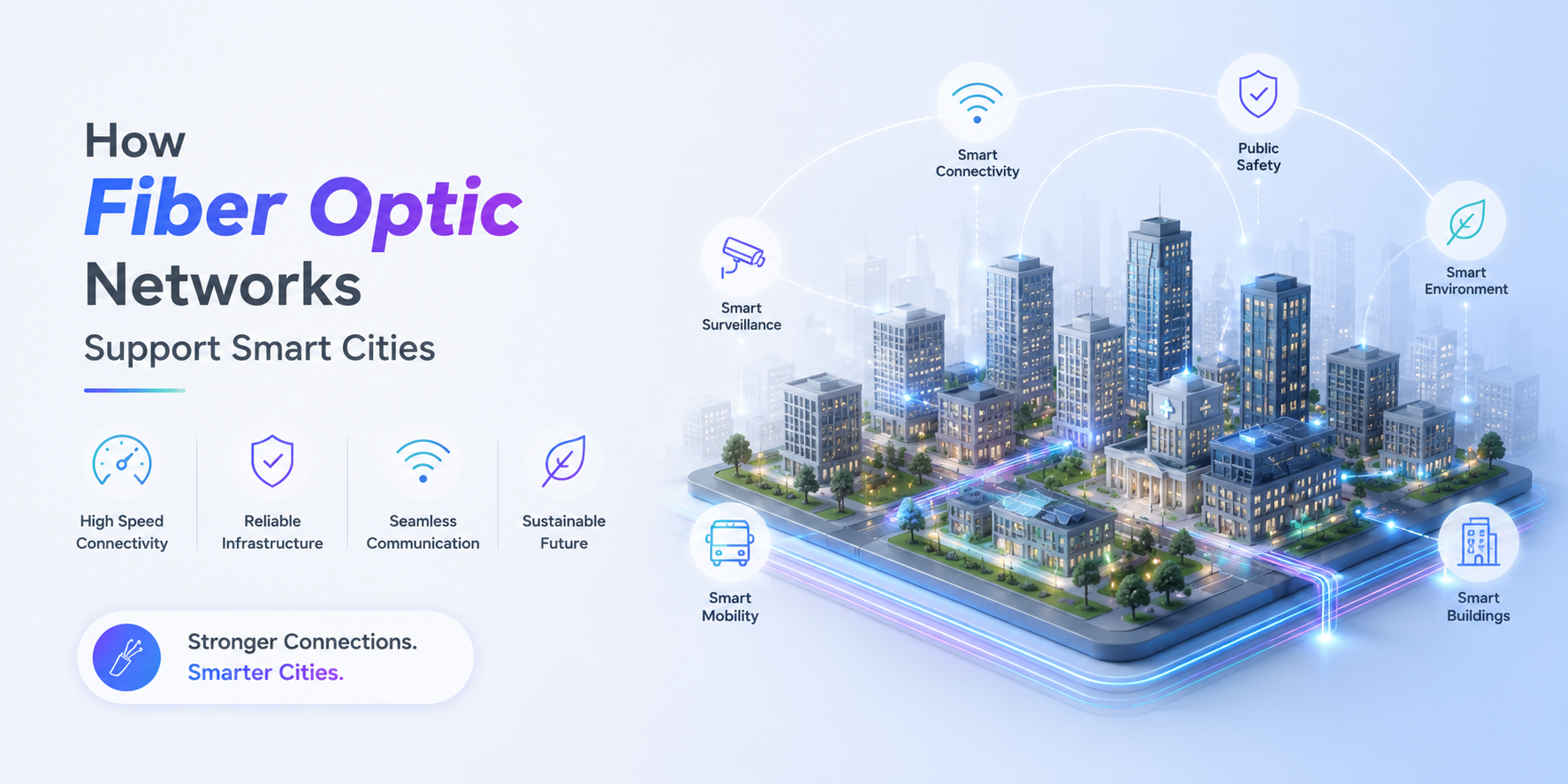
As cities around the world embrace digital transformation, the demand for fast, secure, and reliable communication networks continues to grow. Smart cities rely on connected technologies to improve transportation, public safety, healthcare, energy management, and government services. At the heart of this transformation is fiber optic networking, providing the high-speed infrastructure needed to connect millions of devices and transmit large volumes of data in real time.
Unlike traditional copper-based networks, fiber optic technology delivers greater bandwidth, lower latency, and exceptional reliability, making it the ideal foundation for modern smart city infrastructure.
What Is a Smart City?
A smart city uses digital technologies, sensors, communication networks, and data analytics to improve urban services and enhance the quality of life for its residents. Information collected from connected systems helps city authorities make faster decisions, reduce operational costs, and improve public services.
To support these connected systems, cities require a robust network infrastructure capable of handling continuous data transmission. Fiber optic networks provide the speed and stability necessary for these demanding applications.
Why Fiber Optic Networks Are Essential
Fiber optic cables transmit information using light instead of electrical signals, allowing data to travel over long distances with minimal signal loss. This technology provides significantly higher bandwidth and greater reliability than conventional copper cables.
For smart city applications that require uninterrupted communication, fiber optic networks ensure consistent performance and future scalability.
Key Smart City Applications Powered by Fiber Optic Networks
Intelligent Traffic Management
Fiber optic networks connect traffic lights, cameras, sensors, and monitoring systems, enabling traffic authorities to analyze congestion in real time and optimize traffic flow. This helps reduce travel time, improve road safety, and lower fuel consumption.
Smart Surveillance and Public Safety
Modern surveillance systems require high-bandwidth connectivity for transmitting high-definition video streams. Fiber optic infrastructure supports CCTV networks, emergency response systems, facial recognition technologies, and city-wide security monitoring.
Internet of Things (IoT)
Thousands of IoT devices communicate continuously throughout a smart city. Environmental sensors, parking systems, smart meters, connected streetlights, and waste management systems all rely on fast and stable fiber connectivity.
Smart Energy Management
Fiber optic networks support intelligent power grids by connecting substations, monitoring equipment, and smart electricity meters. This enables utility providers to improve efficiency, reduce outages, and optimize energy distribution.
Healthcare Services
Hospitals and healthcare facilities benefit from high-speed fiber networks for telemedicine, electronic medical records, remote diagnostics, medical imaging, and secure communication between healthcare providers.
Education and Research
Schools, universities, and research institutions depend on fiber optic connectivity for online learning, cloud computing, virtual classrooms, and collaborative research projects requiring high-speed internet access.
Benefits of Fiber Optic Networks for Smart Cities
- Ultra-fast data transmission
- High bandwidth capacity
- Low network latency
- Reliable communication with minimal downtime
- Long-distance signal transmission
- Improved cybersecurity through modern infrastructure
- Support for millions of connected IoT devices
- Scalable infrastructure for future expansion
- Reduced maintenance compared to copper networks
- Energy-efficient network operation
Core Components of a Smart City Fiber Network
A reliable fiber optic infrastructure consists of multiple networking components working together to ensure seamless connectivity.
- Fiber Optic Cables
- Optical Line Terminals (OLT)
- Optical Network Units (ONU)
- Fiber Distribution Boxes (FDB)
- Optical Distribution Frames (ODF)
- PLC Splitters
- Fiber Patch Cords
- Fiber Adapters and Connectors
- Network Cabinets and Racks
- Cable Management Systems
FTTX and GPON in Smart Cities
Most smart city deployments use FTTX (Fiber-to-the-X) and GPON (Gigabit Passive Optical Network) technologies to deliver broadband connectivity efficiently. These technologies allow service providers and municipalities to connect residential areas, commercial buildings, government offices, and public facilities through a shared fiber infrastructure while maintaining high performance and reliability.
Challenges in Building Smart City Networks
Deploying city-wide fiber infrastructure requires careful planning and quality networking equipment. Network designers must consider future capacity, environmental conditions, cable protection, equipment compatibility, and maintenance accessibility. Choosing high-quality fiber optic components significantly improves long-term network performance and reduces operational costs.
Why Quality Networking Solutions Matter
The success of any smart city depends on the reliability of its communication infrastructure. Premium fiber optic cables, distribution equipment, patch panels, cabinets, connectors, and installation accessories help ensure stable data transmission, simplified maintenance, and long-term scalability.
Solitine Fiber Optic Solutions
Solitine offers a comprehensive range of networking and fiber optic products designed for modern communication infrastructure. From fiber optic cables and FTTX solutions to OLTs, ONUs, PLC splitters, ODFs, network cabinets, and structured cabling accessories, Solitine provides reliable products that support smart city projects, enterprise networks, Internet service providers, and industrial applications.
The Future of Smart Cities
As technologies such as artificial intelligence, autonomous transportation, 5G, edge computing, and the Internet of Things continue to evolve, the importance of fiber optic infrastructure will only increase. Cities investing in high-quality fiber networks today are building a strong digital foundation for future innovation, sustainability, and economic growth.
Conclusion
Fiber optic networks are the backbone of every successful smart city. Their unmatched speed, reliability, scalability, and ability to support thousands of connected devices make them essential for modern urban infrastructure. Whether improving transportation, enhancing public safety, managing utilities, or enabling digital services, fiber optic technology provides the connectivity needed to build smarter, safer, and more efficient cities.
With dependable fiber optic and networking solutions from Solitine, organizations can build future-ready communication infrastructures that support the growing demands of smart city development.

0 Comments
Be the first to share your thoughts on this post.
Leave a Comment