





How to Choose the Right SFP Module for Your Network
Introduction
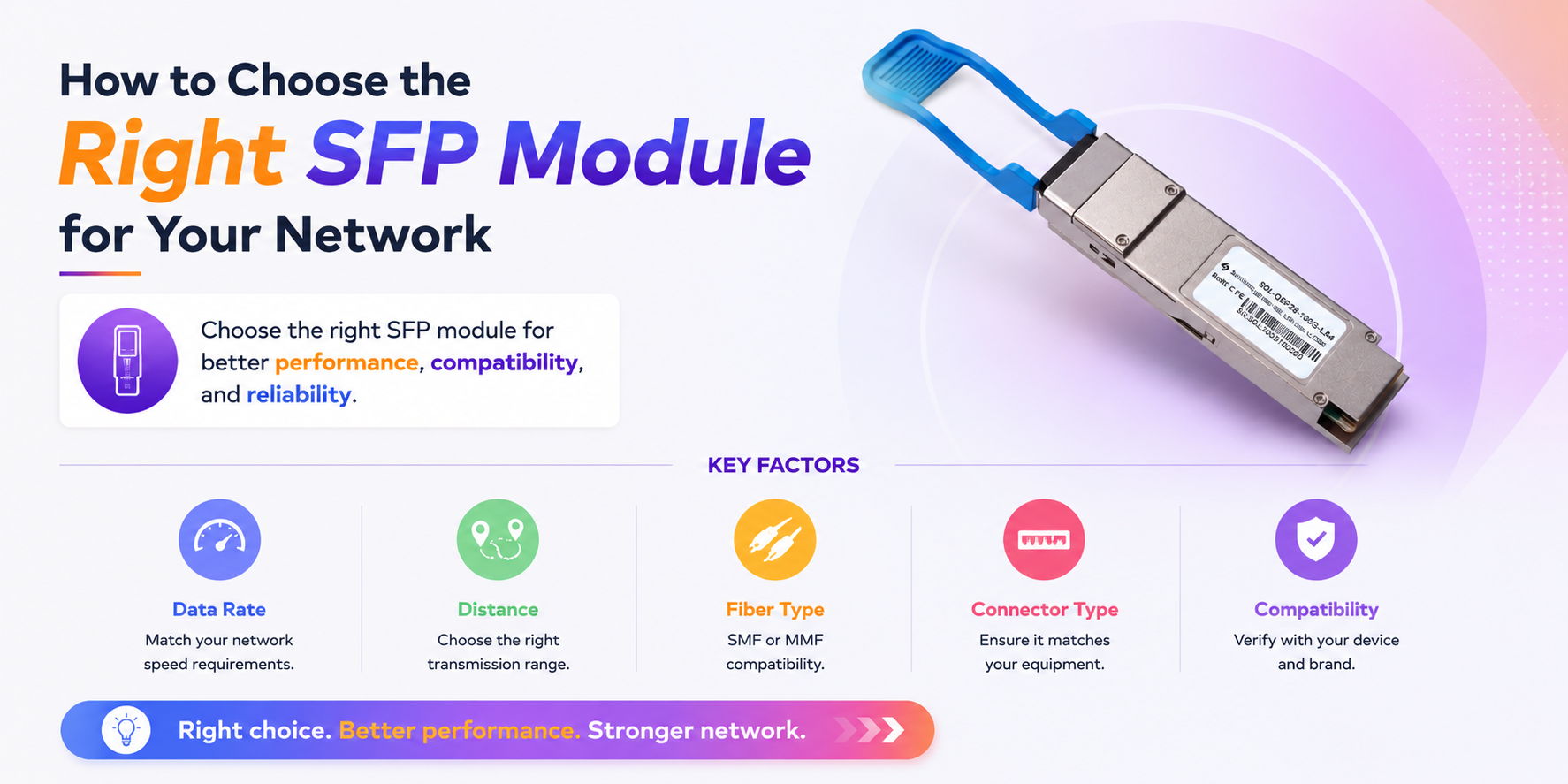
SFP (Small Form-Factor Pluggable) modules are among the most important components in modern fiber optic networks. They enable communication between switches, routers, OLTs, media converters, and other networking equipment while providing the flexibility to support different transmission distances and fiber types.
However, choosing the wrong SFP module can result in compatibility issues, poor performance, increased maintenance costs, and network downtime. Understanding the key selection criteria can help ensure reliable and efficient network operations.
Why Choosing the Right SFP Module Matters
An SFP module acts as the bridge between networking equipment and the transmission medium. Since every network has unique requirements, selecting the proper transceiver is essential for achieving optimal performance.
The right module improves reliability, maximizes bandwidth utilization, and supports future network expansion.
1. Verify Device Compatibility
The first step when selecting an SFP module is ensuring compatibility with your networking equipment.
Different switches, routers, OLTs, and media converters may have specific compatibility requirements. Always verify supported transceiver types before purchasing.
- Managed Switches
- Core Switches
- Enterprise Routers
- GPON OLTs
- EPON OLTs
- Media Converters
2. Determine the Required Transmission Distance
Different SFP modules are designed for different transmission distances.
| SFP Type | Typical Distance |
|---|---|
| SX SFP | Up to 550 Meters |
| LX SFP | Up to 10 Kilometers |
| EX SFP | Up to 40 Kilometers |
| ZX SFP | Up to 80 Kilometers |
Selecting the proper distance rating ensures stable communication and minimizes signal loss.
3. Choose Between Single Mode and Multi Mode Fiber
Single Mode Fiber (SMF)
Single Mode SFP modules are ideal for long-distance communication and are commonly used in ISP backbone networks, FTTH deployments, and telecommunications infrastructure.
Multi Mode Fiber (MMF)
Multi Mode SFP modules are designed for shorter-distance applications such as enterprise networks, campus environments, and data centers.
Using the wrong fiber type can lead to connectivity issues and performance degradation.
4. Select the Appropriate Data Rate
Modern networks operate at different speeds depending on application requirements.
- 1G SFP Modules
- 2.5G SFP Modules
- 10G SFP+ Modules
- 25G SFP28 Modules
Choose a module that matches both your network equipment and bandwidth requirements.
5. Consider Wavelength Requirements
SFP modules transmit optical signals at specific wavelengths. Common wavelengths include:
- 850nm
- 1310nm
- 1490nm
- 1550nm
The transmitting and receiving devices must use compatible wavelengths to establish successful communication.
6. Evaluate Future Network Expansion
Network demands continue to grow due to cloud applications, streaming services, smart devices, and increasing bandwidth requirements.
Selecting scalable SFP solutions today can help avoid costly upgrades in the future.
Common Mistakes When Buying SFP Modules
- Ignoring equipment compatibility
- Selecting incorrect transmission distances
- Using mismatched wavelengths
- Mixing Single Mode and Multi Mode components
- Purchasing based only on price
- Overlooking future scalability needs
Applications of SFP Modules
- FTTH Networks
- Internet Service Providers
- Enterprise Networks
- Data Centers
- Telecommunications Infrastructure
- Campus Networks
- Industrial Networking
- Cloud Computing Environments
Why Network Professionals Prefer High-Quality SFP Modules
Reliable SFP modules provide stable connections, lower packet loss, reduced downtime, and longer operational lifespans. High-quality transceivers also improve overall network efficiency and reduce maintenance costs.
For mission-critical environments, investing in dependable networking components is essential.
SOLITINE SFP Solutions
SOLITINE offers a wide range of SFP transceivers designed for ISP networks, enterprise deployments, FTTH infrastructure, and data center environments. Engineered for compatibility, reliability, and high-performance connectivity, SOLITINE SFP modules help organizations build scalable and efficient network infrastructures.
Whether you require Gigabit SFP modules, long-distance transceivers, or enterprise-grade fiber connectivity solutions, SOLITINE provides products that meet modern networking demands.
Conclusion
Choosing the right SFP module involves more than simply selecting a transceiver. Compatibility, distance requirements, fiber type, data rate, wavelength, and future scalability must all be considered to ensure optimal network performance.
By understanding these key factors, organizations can build reliable, high-speed fiber networks that support both current requirements and future growth.

0 Comments
Be the first to share your thoughts on this post.
Leave a Comment