







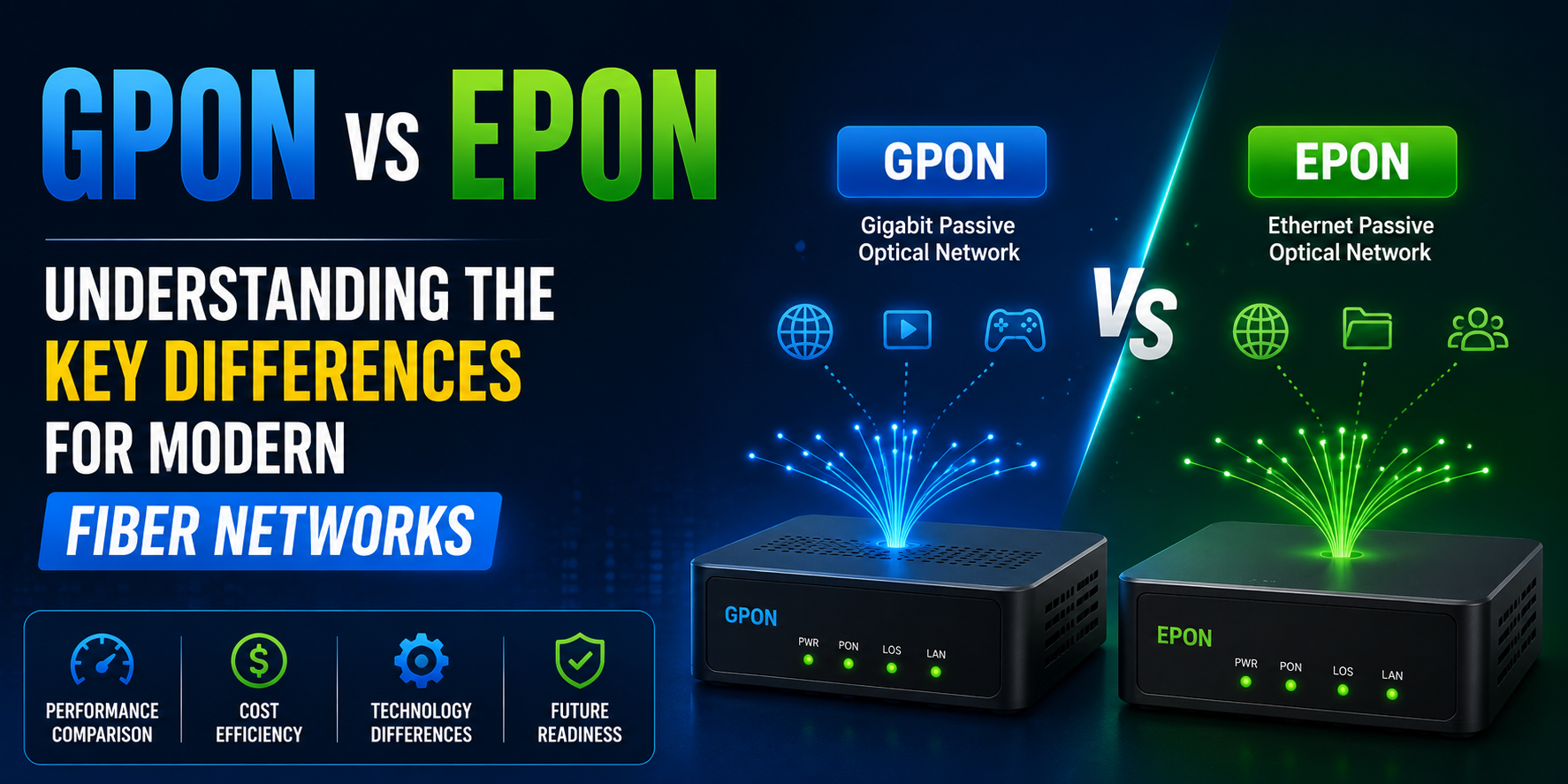
GPON vs EPON: Understanding the Key Differences for Modern Fiber Networks
Introduction
As demand for high-speed internet continues to grow, fiber optic technology has become the preferred choice for Internet Service Providers (ISPs), businesses, and residential users. Among the most widely deployed Passive Optical Network (PON) technologies are GPON and EPON.
While both technologies deliver high-speed broadband services over fiber optic infrastructure, they differ in architecture, performance, efficiency, and deployment scenarios. Understanding these differences is essential when planning a modern fiber network.
What is GPON?
GPON (Gigabit Passive Optical Network) is a telecommunications standard designed to provide high-speed voice, data, and video services over a single fiber optic network. GPON is widely adopted by telecom operators and ISPs because of its efficiency and higher bandwidth capabilities.
GPON supports downstream speeds of up to 2.5 Gbps and upstream speeds of up to 1.25 Gbps, making it ideal for bandwidth-intensive applications.
What is EPON?
EPON (Ethernet Passive Optical Network) is based on Ethernet standards and is commonly used for data communication networks. EPON offers symmetrical bandwidth and provides up to 1.25 Gbps for both downstream and upstream traffic.
Its Ethernet-based architecture simplifies deployment and integration with existing Ethernet networks.
GPON vs EPON: Key Differences
1. Bandwidth Performance
GPON typically delivers higher downstream bandwidth compared to EPON. This makes GPON suitable for environments where users consume large amounts of streaming, cloud, and multimedia content.
- GPON: 2.5 Gbps Downstream / 1.25 Gbps Upstream
- EPON: 1.25 Gbps Downstream / 1.25 Gbps Upstream
2. Network Efficiency
GPON uses advanced traffic encapsulation methods that allow multiple services such as internet, voice, and IPTV to be transmitted more efficiently over a single fiber connection.
EPON relies on standard Ethernet frames, which simplifies network management but may offer lower bandwidth efficiency compared to GPON.
3. Cost Considerations
EPON equipment is often more affordable and easier to integrate into Ethernet-based infrastructures. GPON equipment may require a higher initial investment but provides greater scalability and service flexibility.
4. Service Support
GPON was specifically designed to support Triple Play services, including internet, voice, and television services. This makes it popular among telecom operators and large-scale service providers.
EPON is primarily optimized for high-speed data transmission and enterprise networking applications.
5. Global Adoption
GPON has become the dominant technology for Fiber-to-the-Home (FTTH) deployments worldwide due to its higher efficiency and service capabilities.
EPON remains popular in specific markets and enterprise environments where Ethernet compatibility is a priority.
Advantages of GPON Technology
- Higher downstream bandwidth
- Excellent support for FTTH deployments
- Efficient bandwidth utilization
- Supports voice, data, and IPTV services
- Scalable for future network expansion
- Lower operational costs over time
Advantages of EPON Technology
- Simplified Ethernet integration
- Cost-effective deployment
- Symmetrical bandwidth support
- Easy network management
- Suitable for enterprise applications
Choosing the Right Technology
The choice between GPON and EPON depends on network requirements, budget, scalability goals, and service offerings.
For ISPs planning large-scale FTTH deployments and advanced broadband services, GPON is often the preferred solution. Organizations looking for Ethernet-based simplicity and cost efficiency may find EPON to be a suitable alternative.
SOLITINE Fiber Networking Solutions
SOLITINE offers reliable GPON and XPON networking solutions designed for ISPs, enterprises, and fiber network operators. From ONU devices and OLT systems to networking accessories and deployment solutions, SOLITINE provides the technologies needed to build high-performance fiber infrastructures.
Conclusion
Both GPON and EPON are powerful fiber access technologies that enable high-speed broadband connectivity. While GPON delivers superior efficiency and service capabilities, EPON offers simplicity and Ethernet compatibility.
Understanding the strengths of each technology helps network operators and businesses make informed decisions for current and future fiber deployments.

0 Comments
Be the first to share your thoughts on this post.
Leave a Comment