





Cat6 Cable Explained: Why It’s the Best Choice for Modern Networking
Introduction
As internet speeds continue to increase and network demands become more intensive, selecting the right Ethernet cable has become more important than ever. Whether you're building a home network, upgrading an office infrastructure, or deploying an enterprise networking solution, the quality of your cabling directly affects network performance.
Among the various Ethernet cable categories available today, Cat6 Cable has become one of the most popular choices due to its excellent speed, reliability, and future-ready performance.
In this guide, we'll explore what Cat6 cable is, how it works, its advantages, and why it is widely used in modern networking environments.
What is Cat6 Cable?
Category 6 (Cat6) Cable is a standardized twisted-pair Ethernet cable designed to support high-speed data transmission for local area networks (LANs). It was developed as an improvement over Cat5e cable, offering better performance, reduced interference, and higher bandwidth capabilities.
Cat6 cables are commonly used in homes, offices, educational institutions, commercial buildings, and data centers where stable and high-speed network connectivity is essential.
Key Specifications of Cat6 Cable
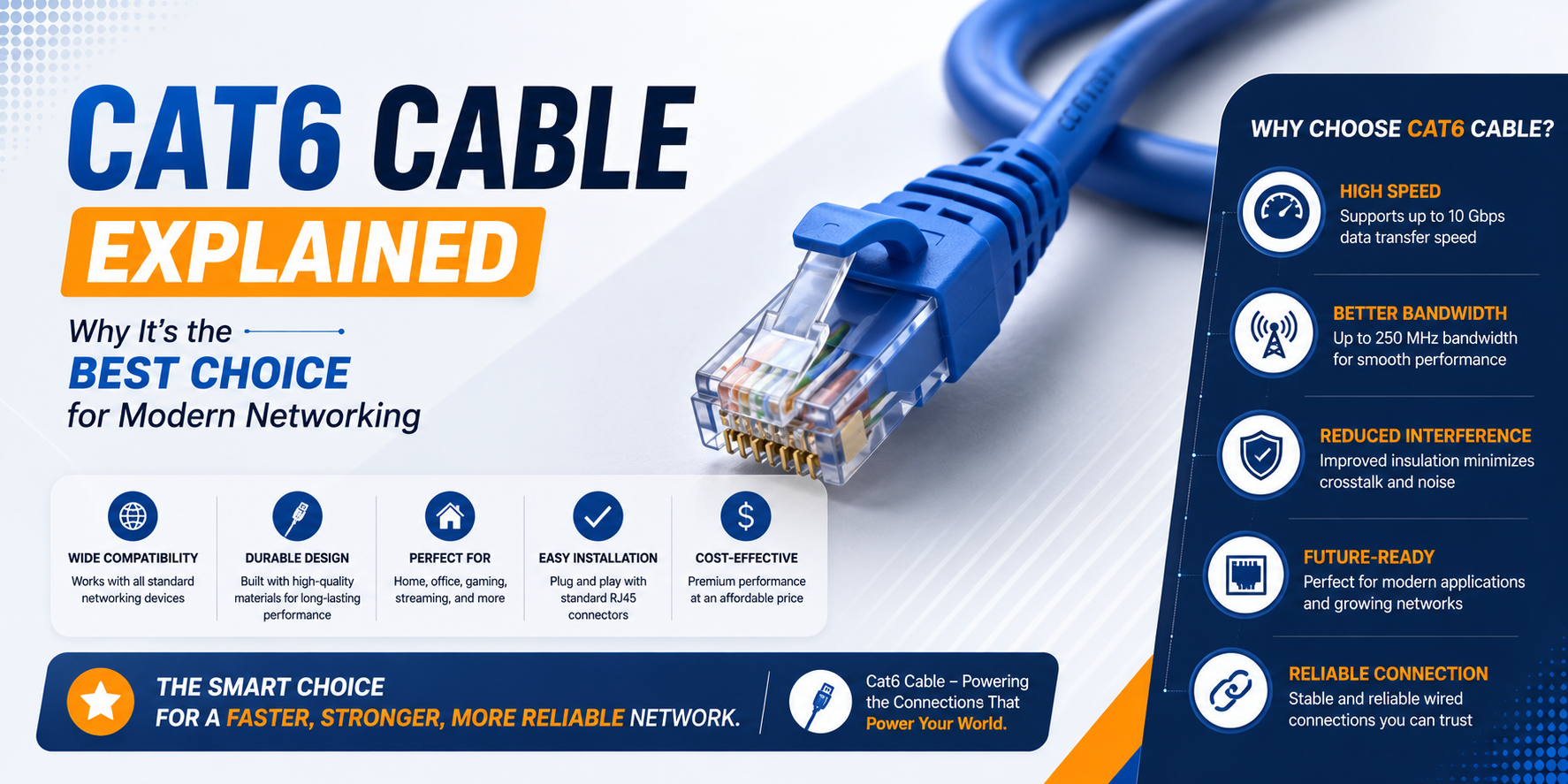
- Bandwidth up to 250 MHz
- Supports speeds up to 1 Gbps at 100 meters
- Supports speeds up to 10 Gbps for shorter distances
- Reduced crosstalk and signal interference
- Suitable for Gigabit Ethernet networks
- Backward compatible with Cat5 and Cat5e networks
How Does Cat6 Cable Work?
Cat6 cable uses four twisted pairs of copper conductors to transmit data. The tighter twists and improved internal design help minimize electromagnetic interference (EMI) and crosstalk between wire pairs.
This enhanced design allows Cat6 cables to deliver faster data transmission and more reliable network performance compared to previous cable generations.
Cat6 vs Cat5e: What's the Difference?
| Feature | Cat5e | Cat6 |
|---|---|---|
| Maximum Bandwidth | 100 MHz | 250 MHz |
| Maximum Speed | 1 Gbps | 10 Gbps (Short Distance) |
| Crosstalk Protection | Standard | Enhanced |
| Network Performance | Good | Excellent |
| Future Scalability | Moderate | High |
Benefits of Using Cat6 Cable
Higher Data Transfer Speeds
Cat6 cables are designed to support Gigabit Ethernet and high-bandwidth applications, ensuring smooth data communication across modern networks.
Reduced Network Interference
The improved internal structure helps reduce signal degradation and electromagnetic interference, resulting in more stable network performance.
Ideal for Modern Applications
Cat6 cable supports bandwidth-intensive applications such as cloud computing, HD video streaming, VoIP communication, online gaming, and enterprise networking.
Future-Proof Investment
As internet speeds continue to increase, Cat6 provides a solid foundation for future networking upgrades without requiring immediate recabling.
Reliable Long-Term Performance
High-quality Cat6 installations offer excellent durability and dependable network connectivity for years to come.
Applications of Cat6 Cable
- Office Networks
- Enterprise Infrastructure
- Data Centers
- Internet Service Provider (ISP) Networks
- IP Surveillance Systems
- Smart Home Installations
- Educational Institutions
- Healthcare Facilities
- Retail and Commercial Buildings
Cat6 Cable for CCTV and IP Cameras
Cat6 cable is widely used for IP surveillance systems because it provides reliable data transmission and supports Power over Ethernet (PoE) technology.
With a single Cat6 cable, both power and network data can be delivered to compatible IP cameras, simplifying installation and reducing infrastructure costs.
Cat6 Cable for Business Networks
Businesses rely on stable connectivity for cloud applications, communication systems, file sharing, and security monitoring. Cat6 cabling helps ensure network performance remains consistent even under heavy workloads.
Its ability to support high-speed switching, wireless access points, servers, and VoIP systems makes it a preferred solution for professional network deployments.
Why Choose High-Quality Cat6 Cable?
Not all Ethernet cables are created equal. Choosing a premium-quality Cat6 cable ensures better signal integrity, improved durability, and consistent performance.
Factors such as conductor quality, shielding, insulation materials, and manufacturing standards significantly impact overall cable performance.
SOLITINE Cat6 Networking Solutions
SOLITINE offers high-performance Cat6 networking solutions designed for homes, offices, ISPs, surveillance systems, and enterprise deployments. Engineered for speed, reliability, and long-term performance, SOLITINE Cat6 cables help build robust network infrastructures that meet modern connectivity demands.
Whether you're expanding an existing network or deploying a new installation, SOLITINE Cat6 solutions provide dependable performance for today's digital environment.
Conclusion
Cat6 cable remains one of the best choices for modern networking due to its superior speed, reliability, and scalability. From business networks and surveillance systems to smart homes and enterprise infrastructures, Cat6 provides the performance required for today's demanding applications.
Investing in quality Cat6 cabling ensures your network remains fast, stable, and ready for future technological advancements.

0 Comments
Be the first to share your thoughts on this post.
Leave a Comment